What if a single field could grow vegetables and generate a megawatt of clean power at the same time — even as summers across Europe get hotter and drier?
That's exactly what's happening in Poland, where AESOLAR Terra E modules sit at the heart of a 1 MW agrivoltaics (AgriPV) research project built with renewable-energy innovator Energia Pomorze. After construction and module installation, the project has entered its first growing season — and the first field measurements are in. This isn't a rendering or a promise. It's a working field, with real crops, real water, and real data.
Farm solar for a warming climate
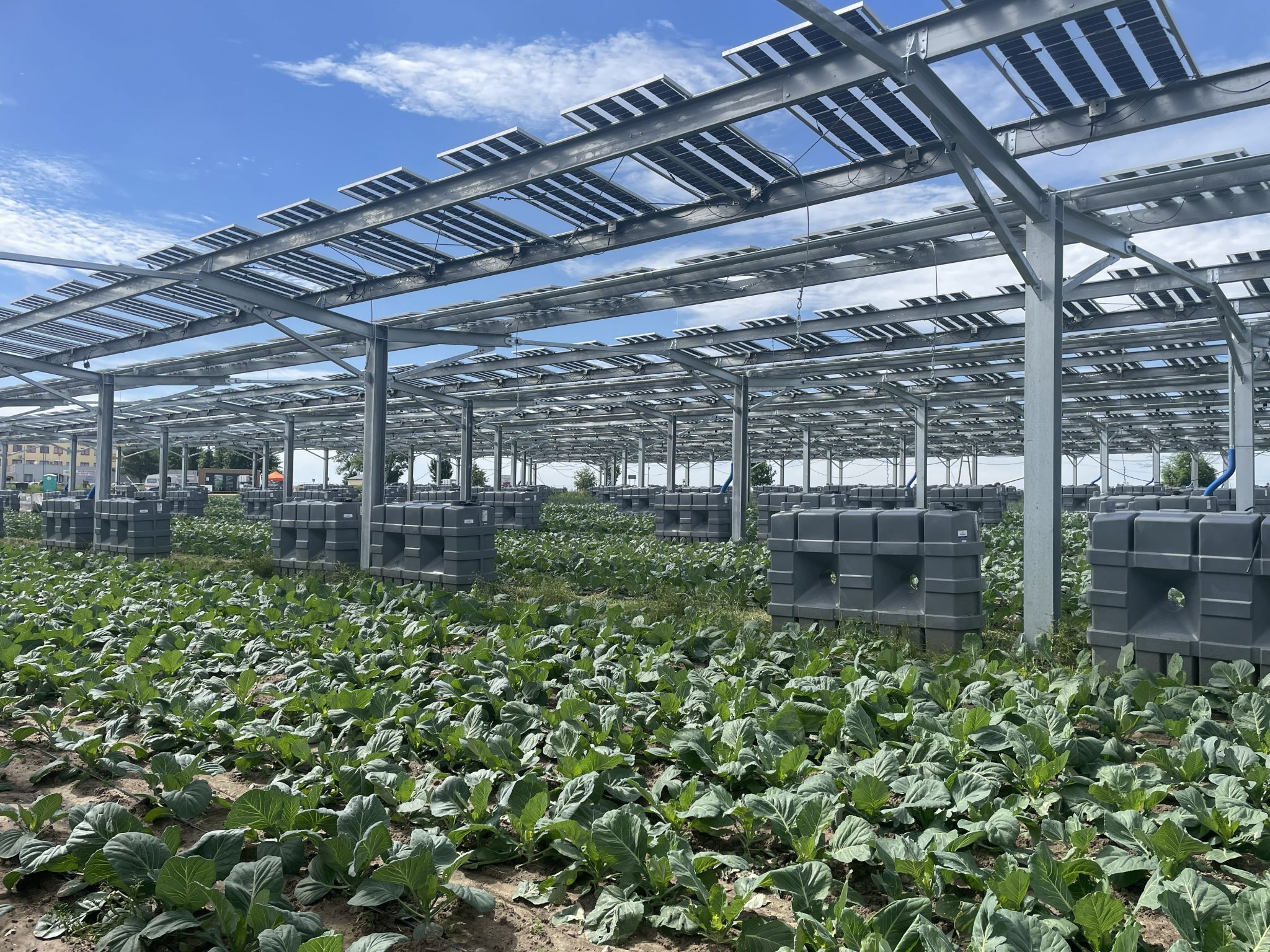
Across Europe, heatwaves now arrive earlier and last longer, stressing crops when growers can least afford it. A conventional solar farm makes that worse — land goes under panels and out of production, for good. Agri PV flips it: panels are elevated so crops keep growing underneath, while the structure shades heat-sensitive plants, harvests rainwater, and still produces power — turning peak heat into an added revenue stream. Panels that block too much light, or footings that seal the soil, still defeat the purpose — this project was engineered agriculture-first from day one.
The project at a glance
Location: Poland
Partner: Energia Pomorze Sp. z o.o.
Capacity: 1 MW
Modules: 2,496× AESOLAR Terra E CMD-96BD 395 W
Crops under the modules: spring onion, white cabbage, leek, celeriac
Expected output: ~1,000 MWh clean electricity per year
Expected impact: ~700 tonnes of CO₂ avoided per year*
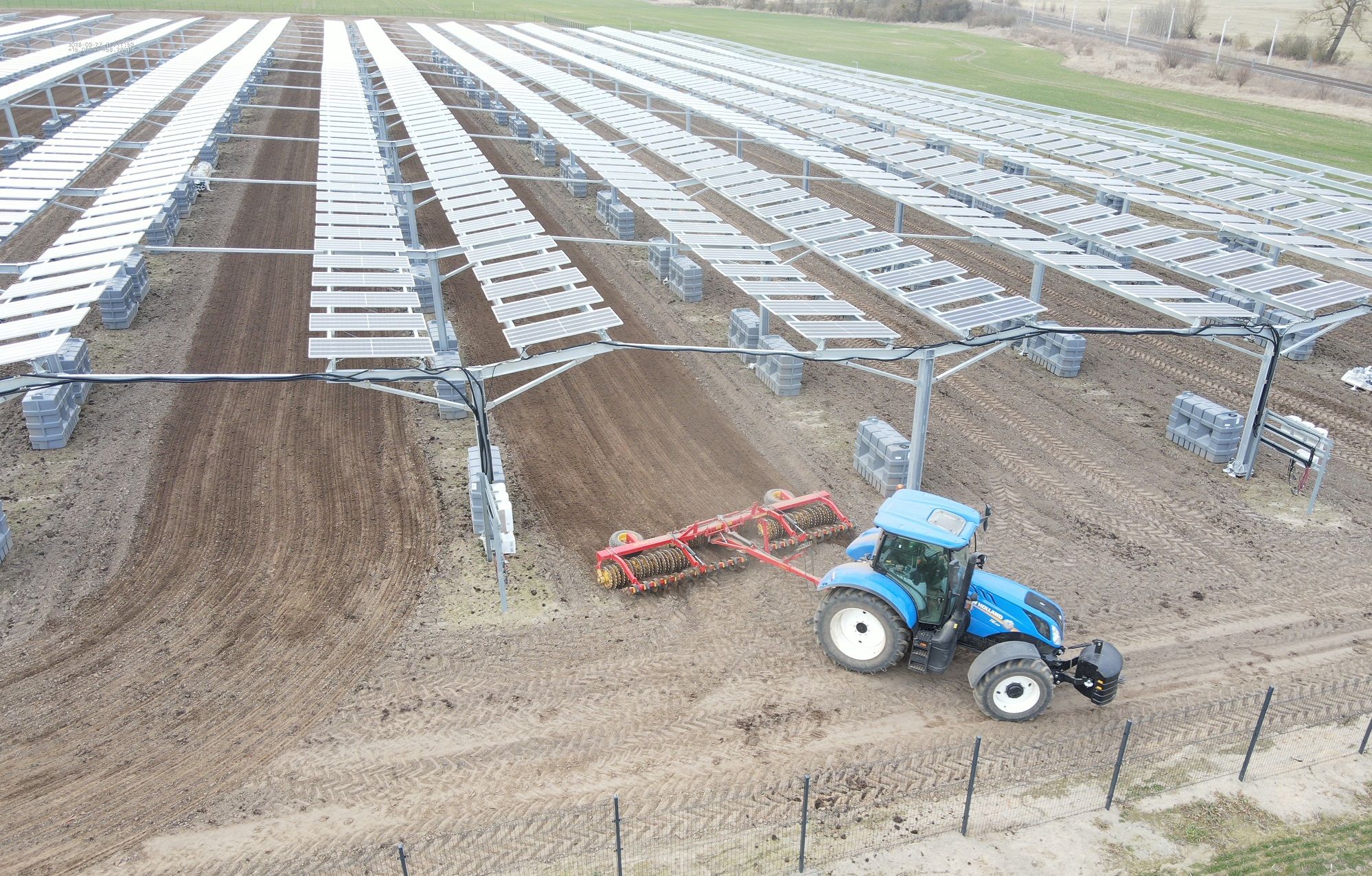
Area: 2 hectares x 17 East–West rows, up to 140 m each
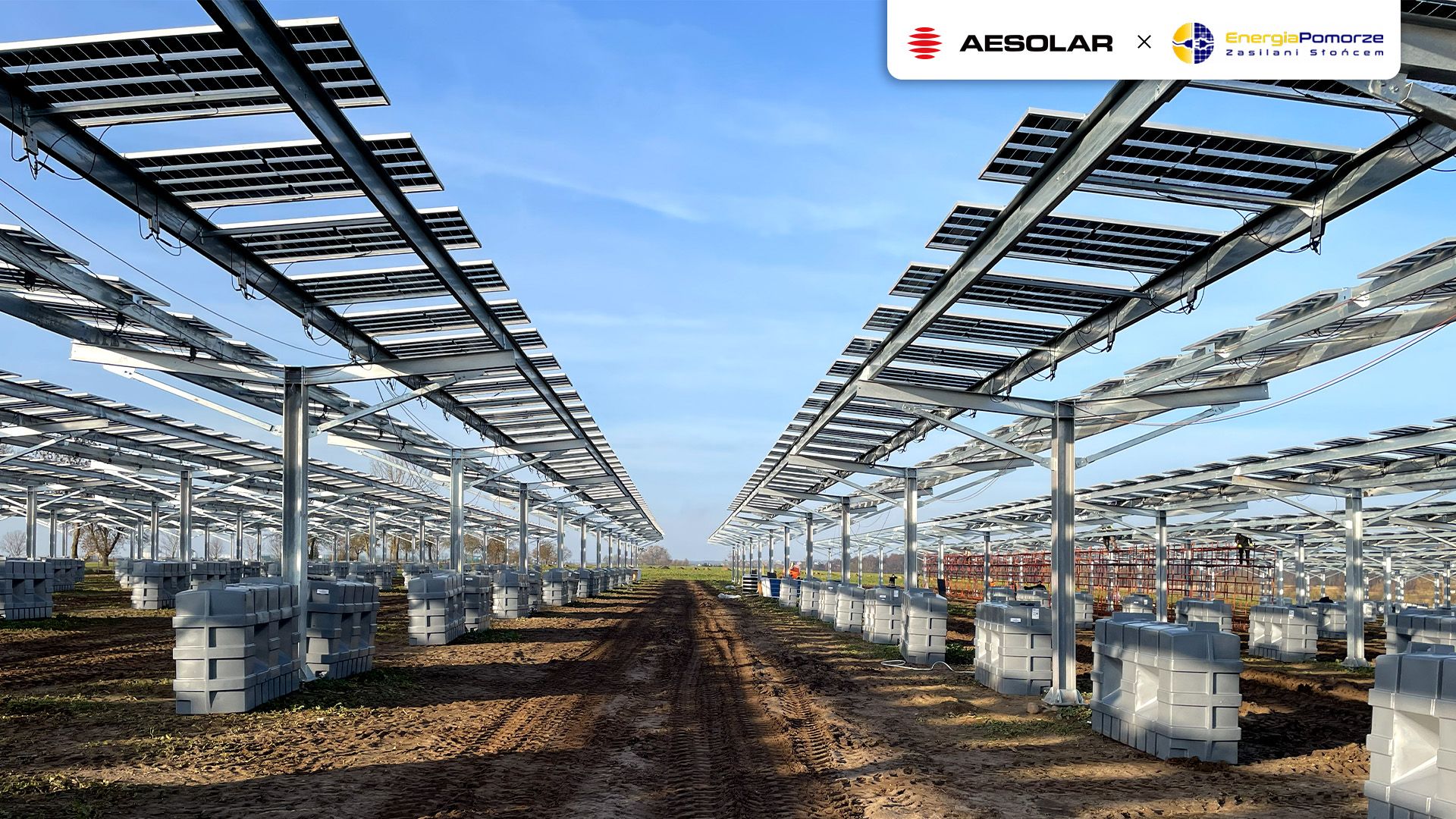
Structure: AgriPV TR System (by Energia Pomorze) — V-shaped, ~4 m clearance, ~10 m between pillars and rows
Water: integrated rainwater harvesting → drip irrigation
Type: scientific pilot, co-financed by Poland's National Centre for Research and Development (NCBR)
The first result: cooler soil, collected water, generated electricity
The first field data points to three results at once.
Cooler soil: thermal imaging found soil in direct sun reaching 43.6, 44.3, 47.3 and 47.9 °C — the kind of heat now common across European summers — while zones shaded by the Terra E structure read 26.2, 27.9, 31.8 and 32.8 °C, a gap of up to roughly 15–16 °C.
Collected water: Energia Pomorze's AgriPV TR System feeds 600,000-litre tanks that capture rainwater for drip irrigation, recirculating water that would otherwise be lost.
Generated electricity: the same structure keeps producing clean power overhead.
Evaporation, soil moisture and radiation are all being measured against a neighbouring reference field, and Energia Pomorze updates the first results are "we see that it is very good."
Why Terra E makes the difference
Not every panel suits agrivoltaics. Terra E was built for it: 40% light transmission delivers even light to the crops below, while up to 395 W, N-type TOPCon bifacial cells (80%) and a double-glass + POE construction — backed by up to a 30-year product warranty — keep output strong in the heat. Light and shade for the crops, power and income for the farm, on the same land.
More with less
Poland's 1 MW AgriPV project shows what happens when the right module meets a warming climate: cooler, moister soil through the hottest months, crops that keep growing, and an extra income stream that has nothing to do with the harvest. This is dual land-use, proven in the field.
FAQ
- What is agrivoltaics (AgriPV)?
Agrivoltaics — sometimes called agri PV or farm solar — places elevated solar modules above growing crops, so the same land produces both food and clean electricity, with shade that cuts evaporation and stabilises soil temperature.
- Do the modules harm the crops below?
Only if the wrong used. Terra E is a transparent module with 40% light transmission, designed to let an appropriate amount of light reach the crops. In Poland, spring onion, cabbage, leek and celeriac are already growing under the structure, with growth measured against a reference field.
- How much cooler is the soil?
At measured spots in this project, shaded soil read 26.2–32.8 °C versus 43.6–47.9 °C in direct sun — up to roughly 15–16 °C cooler. These are spot thermal readings from the first growing season; longer-term averages are being collected.
- Does this only help during heatwaves?
No, but the effect is most visible then: shade and moisture retention matter most during Europe's hottest, driest stretches, exactly when unshaded crops are most at risk.
Explore Terra E for your project
👉 Wondering whether agri PV is right for your farm, land, or portfolio? See what AESOLAR Terra E can do — explore the module at https://ae-solar.com/products/TerraE and get in touch with our team to discuss your project. Let's put energy, water and agriculture on the same land, together. 🌱
The AgriPV TR System and its water-collection infrastructure are developed and operated by Energia Pomorze. Explore Poland's AgriPV TR System solution by Energia Pomorze: https://energiapomorze.pl/agrofotowoltaika-a-praktyki-regeneratywne-gleby/