Solar carports are quickly becoming one of the most practical applications in distributed solar. Instead of competing for ground space, a solar pv carport turns an already-paved area — a parking lot, driveway, or fleet yard — into a power plant, while doubling as shelter from sun, hail, and snow. For commercial sites, logistics hubs, and EV charging infrastructure, a car port pv system delivers clean power and covered parking from the same footprint — no additional land, no compromise.
But a carport roof is different from a rooftop array in one critical way: people, vehicles, and property sit directly underneath it. That changes the safety bar entirely.
How Is Safety Guaranteed?
A standard PV module is designed to sit on a roof — not to serve as the roof itself, over people's heads. In Germany, PV modules are classified as "unregulated construction products," meaning any module used in a load-bearing or overhead role — a solar panel carport roof, a canopy, a walkway — legally requires a specific structural approval before it can be installed above usable space.
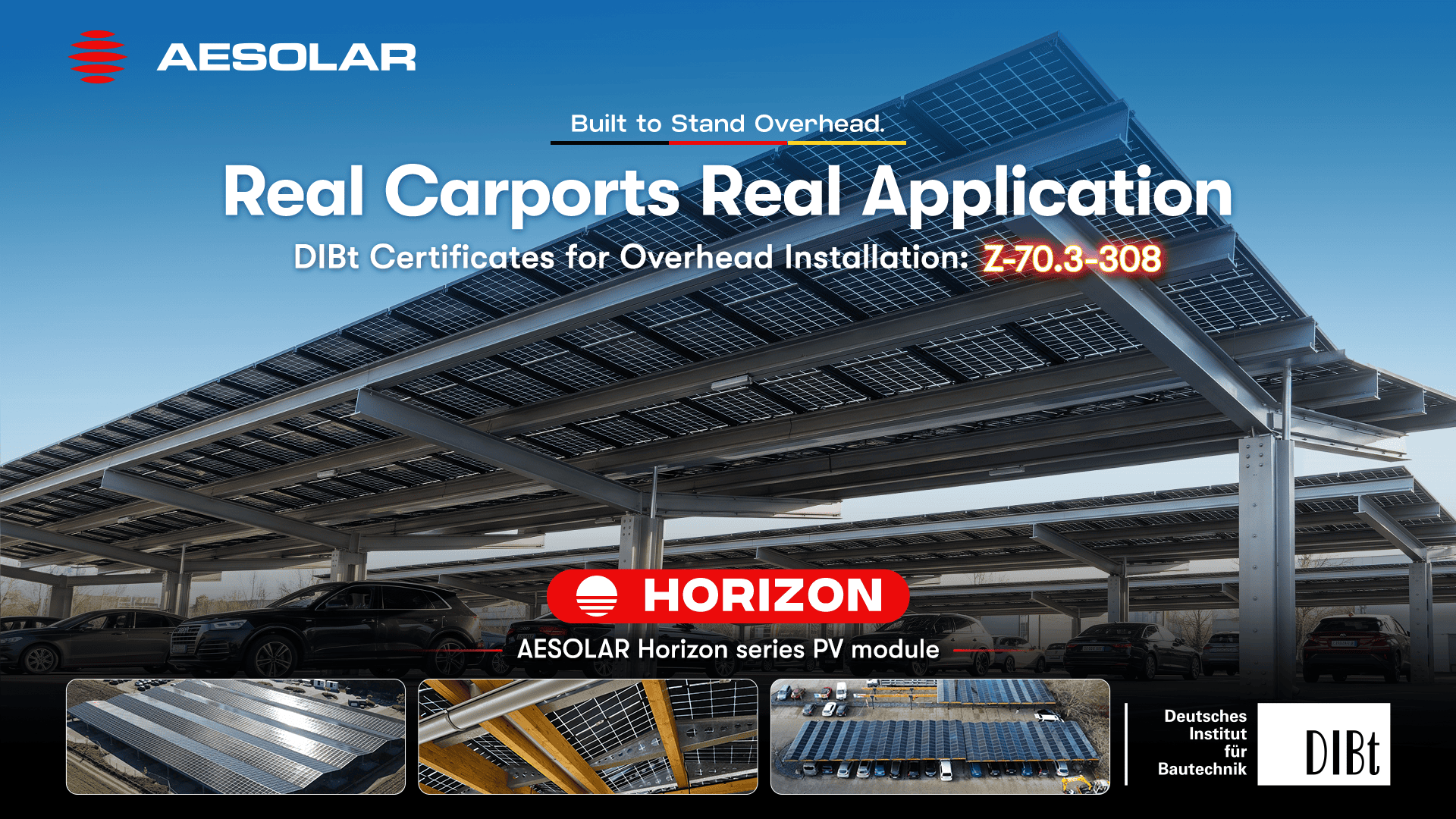
AESOLAR's Horizon series modules are engineered and tested to meet that bar. Independent testing confirms performance against DIN ISO 12543-4 (durability), DIN EN 12600 (impact resistance), DIN EN 18008-1 & 2 (mechanical load-bearing), DIN EN ISO 8510-2 (adhesion, keeping the glass intact overhead), and DIN 4102-1 (fire resistance). In practice, Horizon modules are built to stay structurally safe under mechanical stress, so a solar carport can be certified as a genuine building component — not just panels bolted onto a frame.
The Meaning of Germany's DIBt Certificate
That safety case is formalised by DIBt (Deutsches Institut für Bautechnik) — Germany's national authority for approving construction products and techniques. DIBt certification for overhead PV confirms a module meets German building-code requirements for structural integrity, fire resistance, and safety when installed above people or vehicles.
AESOLAR's Horizon series holds DIBt approval number Z-70.3-308, granted 2 May 2025 and valid through 2 May 2030 — covering both a General Building Approval (abZ) and a General Design Certification (aBG). This makes AESOLAR the first Tier 1 PV module manufacturer in the industry to achieve DIBt certification for overhead installation, a distinction since referenced across the industry.
For developers and EPCs, that certificate isn't a marketing footnote — it's often the difference between getting a permit and not. Without DIBt approval, overhead PV projects can require costly individual structural sign-off, or may not be approved at all.
Beyond Carports: Every Overhead Structure
DIBt certification for overhead installation opens the door well past the parking lot. The same Horizon modules can be applied to canopies and pergolas, walkways and covered passageways, glazed roofing over building entrances, and sunroom or conservatory-style structures where people sit or walk directly beneath the glass. Anywhere a structure needs to double as both shelter and power source, DIBt-certified overhead PV turns dead architectural space into a revenue-generating surface.
Horizon: Built for the Job
AESOLAR Horizon modules combine that overhead-safety case with real performance: 420W-440W CMD108-BDS series or 570W-590W CMD-144BDS, with an operating range of -40°C to +85°C, Class 4 hail resistance, a bifacial glass-glass build with 8% light transmission for shaded but not dark spaces below, and a product warranty of up to 30 years.
Real projects across the DACH region are already proving it out — Horizon carports shading vehicles, generating power, and standing up to German construction standards at the same time.
See the Horizon series at: ae-solar.com/products/Horizon